

Safer Tourism launches She Travels Safe as research shows reality of ‘avoidance tax’ for women
Travel should be one of life's great pleasures. For most people, most of the time, it is. Yet our most recent research shows how different the experience of planning and taking a trip can be, depending on whether you’re a woman or a man. The findings reveal that less than half of women (49%) feel confident managing their personal safety when travelling solo or with other women. This insight sits alongside our own global traveller incident data, which recorded a 60% rise in reported incidents of sexual harassment and assault in 2024.
We’re launching She Travels Safe, a new campaign which aims to arm women with information, tools and knowledge gained from travellers’ first hand experiences to close the confidence gap and help more women travel safely.
A different kind of safety challenge
Katherine Atkinson, CEO of the Safer Tourism Foundation, is clear that the rise in reported incidents does not tell a simple story. "It is encouraging that more travel operators are creating environments where travellers feel able to report," she says. "This is important progress, and something Safer Tourism Pledge partners have worked hard to achieve. But better reporting alone does not explain a rise of this scale."
On the surface, the research appears to show that men experience more safety challenges than women while travelling. Men are more likely to report theft, scams or financial concerns (22% vs 17%), inadequate accommodation security (18% vs 13%) and inappropriate behaviour from fellow travellers (16% vs 10%). But dig deeper into the data and a more nuanced picture emerges.
Nearly one in four women (23%) report having experienced unwanted attention or harassment while travelling, compared to 15% of men. And crucially, the most telling gap between male and female travel experience doesn’t show up in what happens. It shows up in what women actively avoid to prevent anything from happening at all.
The avoidance tax
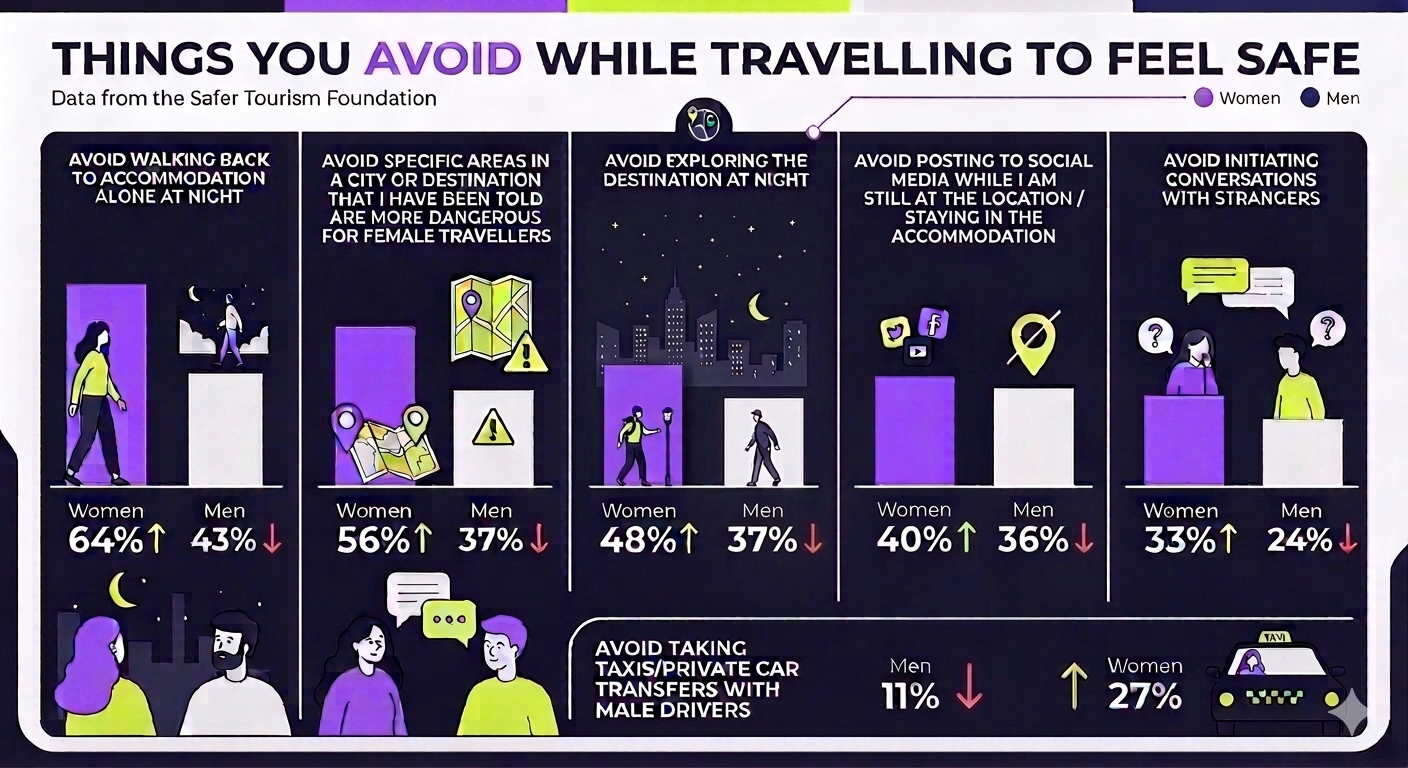
The Safer Tourism Foundation describes this phenomenon as the "avoidance tax": the accumulation of restrictions women place on their own behaviour in order to feel safe, restrictions that most male travellers simply never think about.
The data is striking. While 64% of women say they avoid walking back to their accommodation alone at night when travelling abroad, only 43% of men do the same. More than half of women (56%) say they avoid specific areas of a city they have been warned are more dangerous for female travellers, compared to 37% of men. Nearly half of women (48%) avoid exploring their destination at night altogether. A quarter (27%) say they avoid taking taxis or private car transfers with male drivers, a figure that drops to just 11% among men.
"As at home, when women travel they make constant adjustments that most men don't even consider," says Atkinson. "When women aren't travelling, it's clearly not because they are less adventurous than men, but rather that they face a different risk environment."
The research also reveals that women shoulder a disproportionate share of pre-trip safety preparation. Women are more likely than men to purchase travel insurance (63% vs 54%), more likely to keep a written record of important phone numbers (47% vs 41%), and more likely to book transport specifically to arrive at their destination during daylight hours (36% vs 28%). They are also more likely to keep friends and family regularly updated while away (53% vs 46%).
She Travels Safe
The findings sit at the heart of the campaign we are launching this week. She Travels Safe is designed to give women the practical tools and knowledge to travel confidently and to encourage the travel industry to meet them halfway.
The campaign is built around first-hand experience rather than generic warnings, collecting guidance from women who travel sharing real-world advice on everything from pre-trip planning to what to do if something goes wrong. It also includes bystander intervention tools, guidance designed to help any traveller recognise when someone might need support and feel equipped to help safely.
"Bystander intervention techniques have been shown to be effective in reducing and calling out harassment around the world, whoever you are," says Atkinson. "These tools are not just useful for women."
The campaign also highlights the value of booking with a trusted travel providers and signposts travellers towards Safer Tourism Pledge Partners, operates who commit to a framework articulating a stringent approach to traveller health, safety and risk management.
What women want from the industry
The research makes clear that women are not asking for travel providers to do anything unreasonable. Nine in ten women (88%) say it is important for travel companies to take proactive steps on safety, yet fewer than half say they are satisfied with the safety information they currently receive.
When asked what they most want from providers, the answers are practical and specific. Sixty per cent want round-the-clock support helplines. More than half (51%) want detailed safety guidance tailored to specific trip types. Nearly half (49%) want clear, specific information about accommodation safety, from lighting and locks to staff response protocols.
"Women are not asking for anything unreasonable," says Atkinson. "They want clear information, proactive communication, and to know that the company they've booked with has thought about their safety and will offer support if the worst happens. Women are not going to stop travelling, so making female safety a priority issue is a business no-brainer."
Travel confidently, on your own terms
The She Travels Safe campaign does not argue that travel is more dangerous than it was, or that women should be more afraid. Its central message is almost the opposite: that the knowledge and community to travel well already exist, and that making them more widely accessible is both possible and overdue.
"We believe travel should be a freeing and enriching experience for everyone," says Atkinson. "The She Travels Safe campaign aims to share knowledge and practical tools to ensure women who want to travel can do so on their own terms."